Two free books for high school students. Read them, write your answers right in the book, and talk them through with a real person and AI whenever you want.
What you’re downloading: one book file (.epub), straight from smarthelphq.com. The ebook opens in Apple Books on an iPhone, iPad or Mac. The audiobook file opens in the free ElevenReader app. No sign-up, nothing to install from us, and no personal information asked.
High School Edition
SMART DIRECTION!
Around seventeen you are suddenly expected to decide about college, a career and living on your own, and almost nobody is taught how. This book starts with one question: who is actually directing your life?
Prefer your usual store? You can also buy it on Apple Books or Amazon. Those stores charge their listed price. The download above is free.
Ebook and audiobook
SMART PERFORMANCE!
Productivity asks how much you got done. Performance asks what you can do now that you couldn’t do before. You learn how to learn, and trade “Do I know how to do this?” for “How do I figure this out?”
Prefer your usual store? You can also buy it on Apple Books or Amazon. Those stores charge their listed price. The download above is free.
Works best in Apple Books on an iPhone, iPad or Mac, where you can type or dictate your answers right on the page. On Kindle, write your answers in a notebook. For the audiobook, open the file in the free ElevenReader app.
Try a chapter first
Read a chapter from each book
Each is a complete chapter, exercise and teach-back included, with the same answer pages you’ll find in the book. Type your answers right here. They stay on this device and are never sent anywhere.
SMART DIRECTION!Chapter 1: The Wrong MajorRead the chapterClose
1 The Wrong Major
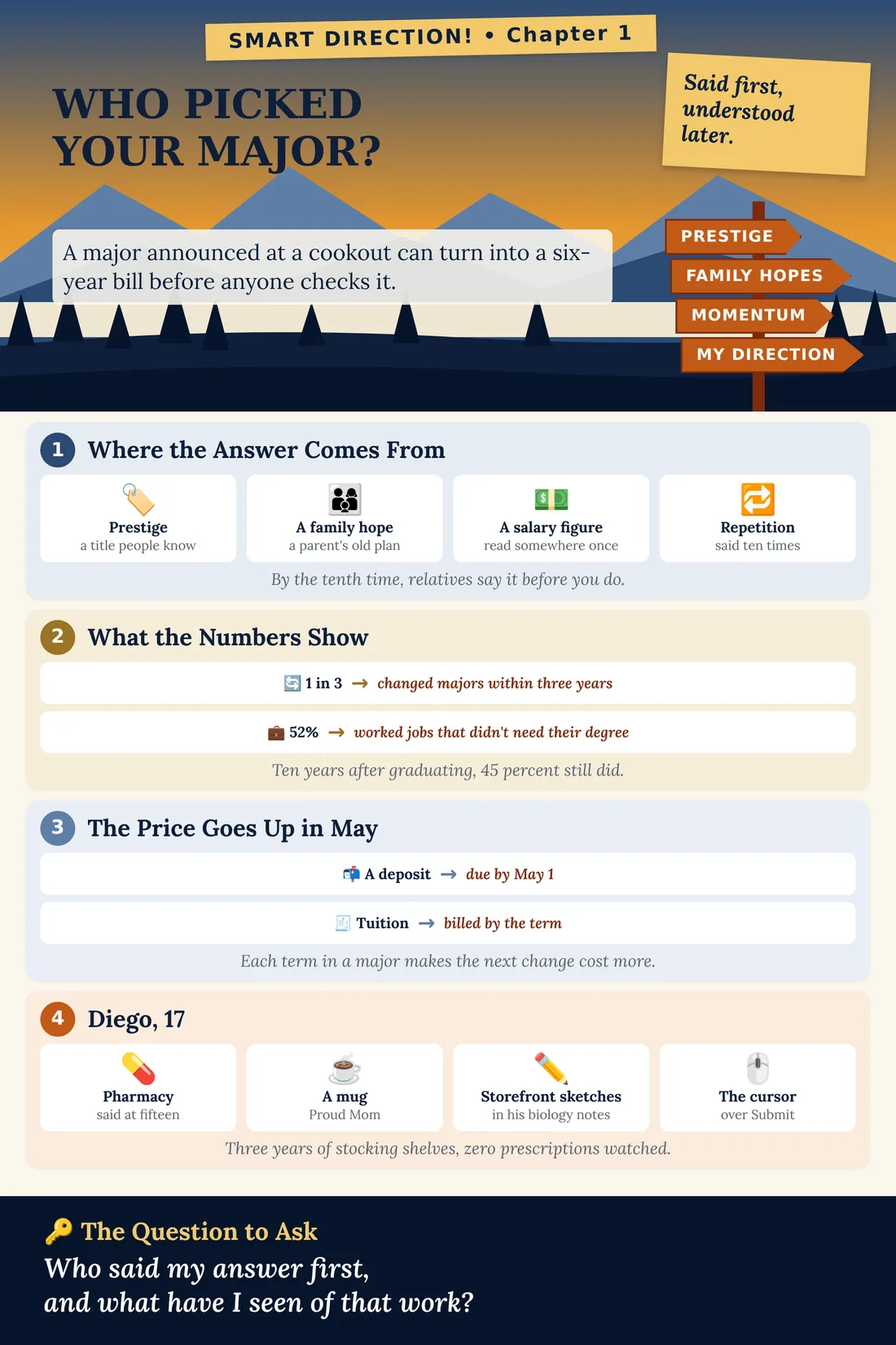
Tap the chart to see it full size.
The Answer at the Party
Somewhere around junior year, adults start asking the same question at every gathering. So, what are you going to study? A cousin asks it over the grill. A neighbor asks it in the driveway. A teacher asks it while handing back a test.
Most students learn to answer fast. The answer that gets the warmest response tends to stick: nursing, engineering, pre-law, business. By the third or fourth time it has been said out loud, it sounds like a plan. By the tenth time, relatives repeat it back before the student opens their mouth. Here comes our future engineer.
A major chosen this way usually arrives from one of two places. Some carry prestige: a title people recognize, or a salary figure someone read about. Others carry a family’s hopes, like the career a parent wanted and never reached, or the business an uncle wants someone to take over. Either way, the student said the word first and found out what it meant later.
What the Numbers Show
A federal study followed students who started bachelor’s degree programs and checked on them three years later. About one in three had changed majors, and about one in ten had changed more than once. Every change was paid for in semesters.1
The bill continues after graduation. A 2024 study of college graduates’ career histories found that 52 percent of four-year college graduates were working in jobs that did not require their degree one year after finishing. Ten years later, 45 percent still were.2
The rates varied widely by field of study.
The Price Goes Up in May
Through high school, a wrong choice of class or club costs a semester and maybe a grade. After graduation, the same kind of guess starts to cost money that has to be borrowed and years that have to be lived. A deposit is due by May 1. Tuition is billed by the term. Each term spent in a major makes the next change feel more expensive, so the major that was said at a cookout at sixteen can quietly become a commitment at twenty.
The contract comes later, when the student checks a box on an application, and the box decides which classes and internships come next.
Case Study: Diego, 17. Pharmacy
Diego’s uncle Tomás has owned a pharmacy in town for twenty-two years. When Diego was fourteen, Tomás let him stock shelves on Saturdays. When Diego was fifteen, Tomás told the whole family at Thanksgiving that Diego had “the head for it.” Diego’s mother cried a little. Diego said, “Yeah, pharmacy,” and that was the answer from then on.
He has said it at every graduation party, every open house and every college visit. His guidance counselor wrote it on his senior plan. His mother has a mug that says Proud Mom of a Future Pharmacist.
Diego has stocked shelves for three years. He has never watched Tomás fill a prescription start to finish, and he has never asked what Tomás does between nine at night and midnight, when the insurance calls get returned. The six-year program Diego is applying to bills by the year, and he has never added up all six.
In biology class, Diego draws in the margins of his notes: storefronts, mostly, with signs and awnings. He rearranges the shelves at Tomás’s store when he gets bored, and three times now, Tomás has kept the new layout. Diego has never mentioned either of those things when someone asks what he wants to do.
In October, his counselor reminds him the early application closes in two weeks. That night, Diego opens the application and selects Pharmacy (PharmD), six-year program from the drop-down menu. His cursor sits over the Submit button while his mother tells his aunt on the phone, in the next room, that he’s almost done.
Smart Direction! Points
A major that has been announced many times gathers its own momentum, separate from any evidence about the person who announced it.
Every person who has heard the answer is one more person a change would have to be explained to.
Exercise: Where the Answer Came From
Part 1 – Diego’s Answer
List every place Diego has said pharmacy out loud, from Thanksgiving at fifteen to the drop-down menu. Next to each one, write who heard it and what they said back. Then list what Diego knows about the job, and what he knows about the work he does when nobody is asking.
Part 2 – Your Answer
Write the answer you give when an adult asks what you’re going to study or do. Then trace it backward. Who said it first, you or someone else? How old were you? How many times have you said it since, and to whom? What did people say back?
Last, write down everything you have actually seen of that work with your own eyes: hours you have watched someone do it, questions you have asked the people who do it, days you have spent inside it. Count the hours, and leave the number on the page.
Teach-Back: Who Picked It?
Find someone in your house who has had a job for at least five years. Tell them about Diego and the mug his mother bought before he had ever watched a prescription get filled.
Then ask them how they ended up in their own line of work, and who said it first. Write down what they tell you, and see whether they can explain Diego’s situation back to you using their own story.
DIR-01-E1 · Exercise · Page 1 of 2
Exercise: Where the Answer Came From
DIR-01-E2 · Exercise · Page 2 of 2
Exercise: Where the Answer Came From
DIR-01-T · Teach-Back
Teach-Back: Who Picked It?
Katherine Leu, Beginning College Students Who Change Their Majors Within 3 Years of Enrollment, Data Point, NCES 2018-434 (Washington, DC: National Center for Education Statistics, U.S. Department of Education, December 2017). ↩
Strada Institute for the Future of Work and the Burning Glass Institute, Talent Disrupted: Underemployment, College Graduates, and the Way Forward (February 2024). ↩
That’s one chapter of SMART DIRECTION!. The whole book is free, with answer pages for every chapter. Download it above.
SMART PERFORMANCE!Chapter 1: The Gap Between Knowing and DoingRead the chapterClose
1 The Gap Between Knowing and Doing
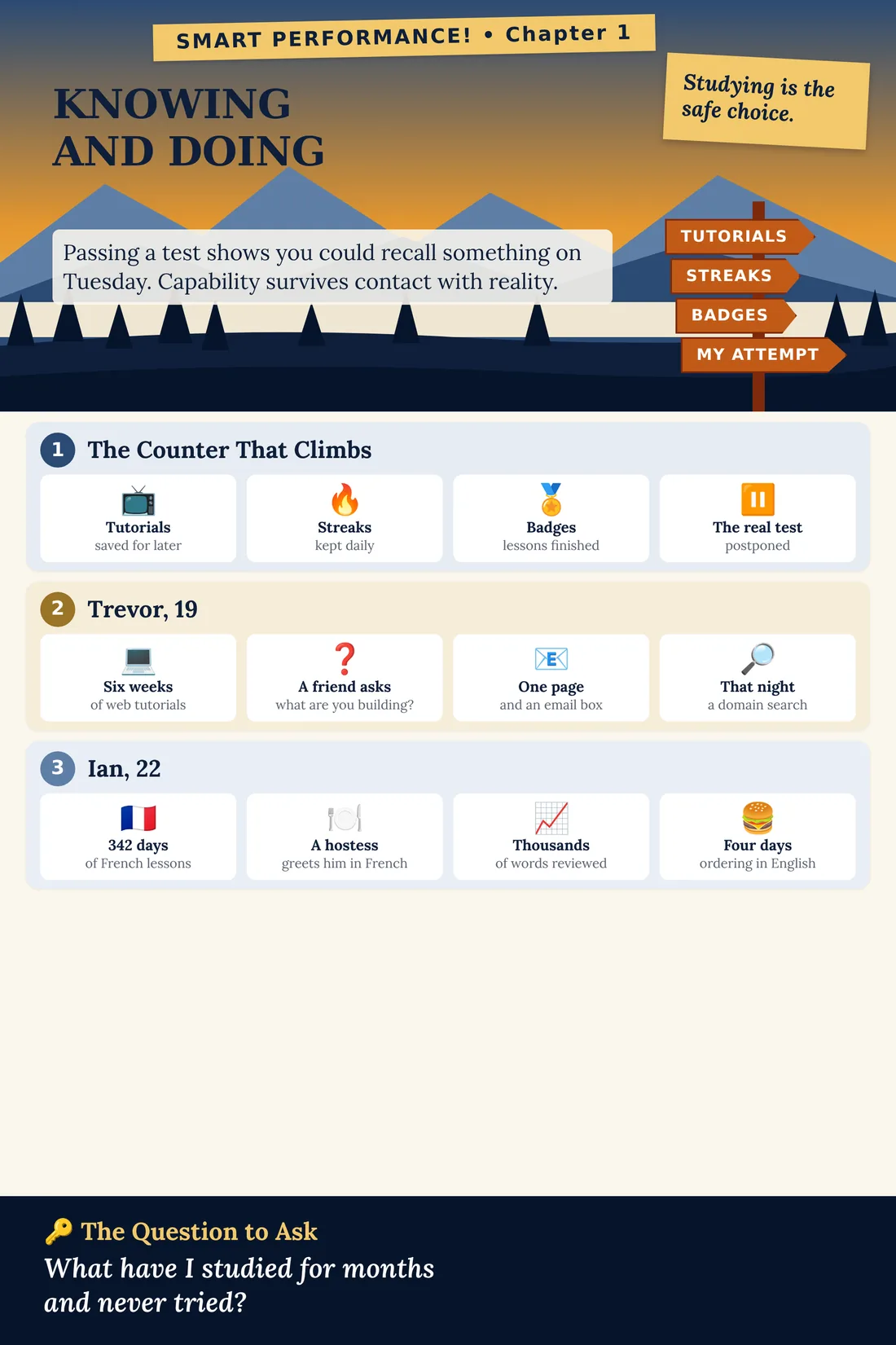
Tap the chart to see it full size.
A playlist of tutorials saved for later. A study guide you can recite, and a test question, worded a little differently, that you can’t touch. A notebook full of what you learned about something you have never once tried.
We Learned to Pass Tests
Most of us spent years being graded on whether we could retrieve information at a particular moment. We developed habits to match: read the chapter, highlight the important parts, memorize the terms, review the night before. When a team of psychologists reviewed ten common study techniques, they rated two of the most popular, rereading and highlighting, among the least useful for learning that lasts.1
Passing a test shows you could recall something on Tuesday morning. Using it is a separate skill. You can understand the principles of budgeting and still be unable to organize your own finances. You can explain negotiation and freeze the moment another person wants something different from what you want. You can know the vocabulary of leadership and still stall when five people are waiting for you to decide.
Capability means the information survives contact with reality.
More Information, Same Ability
Access to information has never been easier. Books, videos, podcasts, courses, a search box that answers almost anything. You can watch three videos about exercise tonight and wake up tomorrow with the same legs.
Each new lesson postpones the moment you find out whether you can do the thing. That postponement feels like progress, because something is being added every day.
The Counter That Keeps Climbing
Points, streaks, badges, and levels count the lessons you finished. A counter that keeps climbing can become the thing you protect, and the skill it was supposed to measure can sit untouched for a year while the number grows.
What Studying Gives You
If information is so much weaker than capability, why do capable people keep choosing it? Studying meets two emotional needs very reliably, and a real attempt, at first, meets neither.
Studying is safe. Nobody watches you fail at a tutorial. It also feels significant: you can talk about the subject, use its vocabulary, and sound like someone who knows. A real attempt exposes you, and for a while it makes you feel less capable than you felt when you were only reading.
So each evening the safer option wins. Months pass. The library grows. The ability to act stays where it was, and the gap between what you know and what you can do gets wide enough that the first real attempt starts to look like a test you are no longer allowed to fail.
Where the Gap Shows
For most of school the gap stays hidden, because most tests ask you to know. It shows up at the first place that asks you to do: a college exam with a problem you have never seen, a first job with no study guide, an interview where someone says, “Walk me through how you would handle this.” People who are very good at studying can walk into those rooms with years of information and very little practice using it.
Case Study: Trevor, 19. Six Weeks of Tutorials
Trevor had wanted to build a simple website since his junior year of high school. He had an idea for a small side project, and the website stood between the idea and the people who might want it. He was taking two classes at the community college and working weekends at a hardware store.
So he started learning web development. He watched tutorials, bought an online course, and became familiar with HTML, CSS, JavaScript, hosting, domains, responsive design, frameworks, and a growing collection of subjects he had never known existed. The more he learned, the more obvious it became how much he did not know.
Six weeks later he knew considerably more about websites than when he began. He still did not have one.
A friend asked him, “What are you actually trying to build?”
Trevor said he needed a clean page describing the idea, a place where someone could leave an email address, and some way to see whether anyone was interested. Saying it out loud, he heard how short the list was. He had spent six weeks studying for something he could describe in one breath.
That night he typed the name of his idea into a domain search. It was available. He looked at the button for a while, pictured a real page and ten people ignoring it, and closed the tab. Then he opened the next lesson. The course had more than thirty left, he had already paid for all of them, and a lesson was something he couldn’t fail.
Case Study: Ian, 22. Three Hundred Forty-Two Days
Ian had done a French lesson in an app every morning for almost a year. Eight months into his first job, his company sent him to Montreal.
On his second evening, a hostess greeted him in French. He answered with a confident “Bonsoir.” She replied, and he understood almost nothing. Within seconds he asked if they could continue in English. She switched without a thought. Ian thought about little else all dinner.
That night in the hotel he opened the app’s progress page: three hundred forty-two days, thousands of words reviewed. He scrolled back through all of it, looking for one time he had spoken French to someone who didn’t know what he was about to say. There wasn’t one.
He ordered every meal for the next four days in English. Every morning, before work, he kept the streak alive.
Smart Points
Studying protects you from finding out where you stand, and that protection is what makes it so easy to choose every night.
Exercise: Thirty Days Ago
Write two columns. In one, everything Trevor and Ian added in their weeks and months of studying. In the other, every moment either of them faced a real person or a real result.
Then choose something you’re working to improve yourself. Leave the hours and the lessons out of it, and finish this sentence:
Thirty days ago I couldn’t ______________________. Now I can ______________________.
If you can’t finish it, write down what you have been counting instead: hours, lessons, videos, pages, days in a row.
Teach-Back: The Button He Didn’t Press
Pick someone who knows you well. Before you say anything about this chapter, ask them what they think you have studied the most in the last year without ever trying it. Write their answer down word for word.
Then read them the paragraph where Trevor looks at the button and closes the tab, and see whether they draw the line between the two on their own.
PER-01-E1 · Exercise
Exercise: Thirty Days Ago
PER-01-T · Teach-Back
Teach-Back: The Button He Didn’t Press
John Dunlosky, Katherine A. Rawson, Elizabeth J. Marsh, Mitchell J. Nathan, and Daniel T. Willingham, “Improving Students’ Learning With Effective Learning Techniques: Promising Directions From Cognitive and Educational Psychology,” Psychological Science in the Public Interest 14, no. 1 (2013): 4–58. ↩
That’s one chapter of SMART PERFORMANCE!. The whole book is free, with answer pages for every chapter. Download it above.
Tell Scott what’s going on, and he’ll write back to you personally with where to start in the books and one thing to try this week. No newsletter, no list. Just a conversation.
Books and courses talk at you. Here we talk to each other. Ask questions, argue your side, change your mind, and work it out together with AI and real experts, as much or as little as you want.
The conversation goes wherever you need it to, and it remembers where you left off.
Converse about your answers, any time
Debate the ideas until they hold up for you
Negotiate a plan that fits your real life
Summarize where you stand whenever you ask
Collaborate with AI and a human expert on what comes next
Start here
Discover what’s really holding you back
The Discovery pages are at the end of each book. Answer what you can, in your own words, and send them. Partial answers are welcome.